Secondhand Exchange Puts a Thrift Store Sitcom at the Center of Vertical Comedy
Jourdain Fisher and Max Manticof's 24-episode Secondhand Exchange has reportedly reached 17 million views, raising the question of whether sitcoms can grow in vertical.

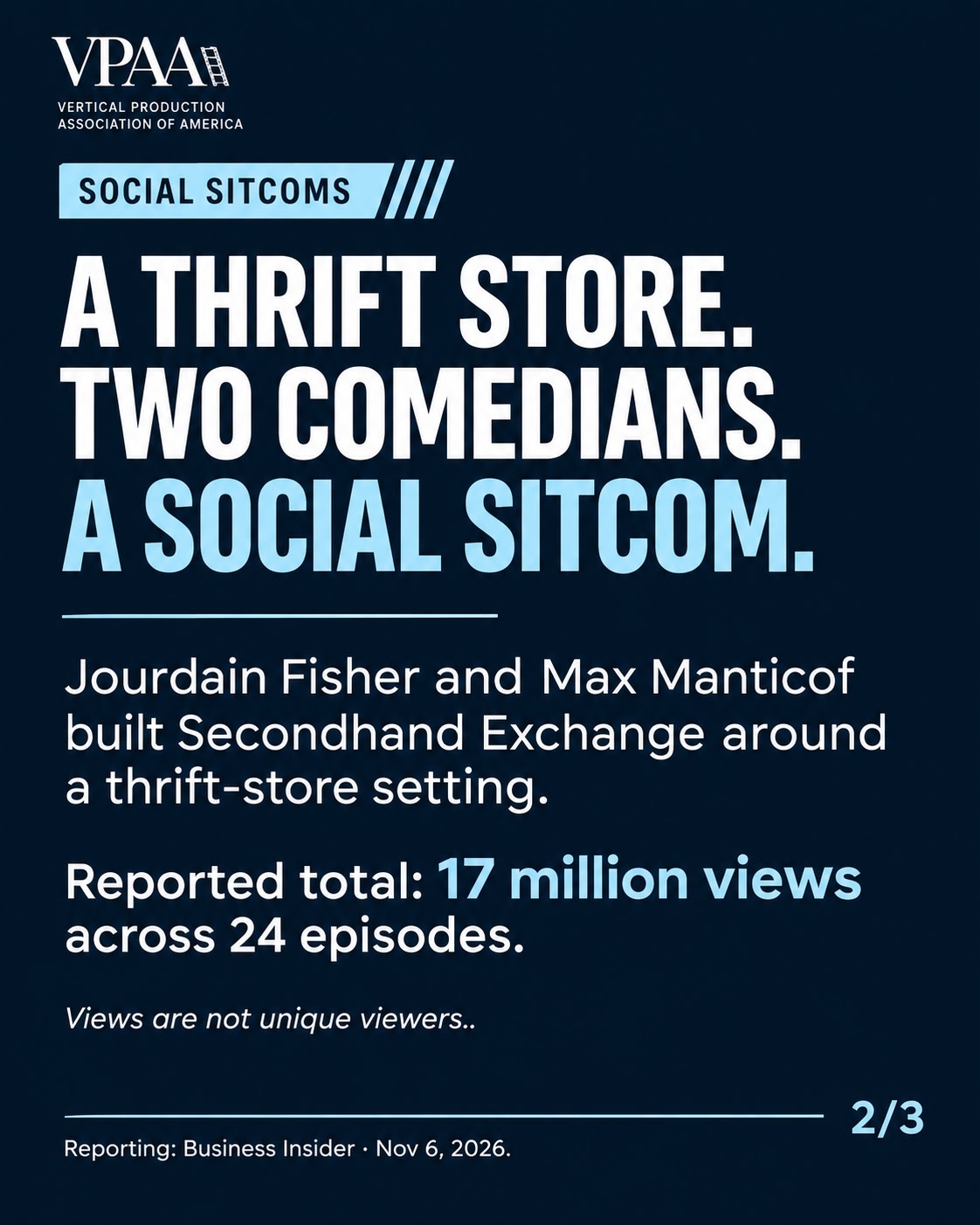

A comedy set in a thrift store is drawing attention to a corner of vertical storytelling that has so far received less notice than its dramatic counterparts. Secondhand Exchange, created by Jourdain Fisher and Max Manticof, runs 24 episodes and has reportedly reached 17 million views, according to Business Insider reporting published November 6, 2026. The figures reflect that report.
A Sitcom Built for the Vertical Frame
The series is built on two familiar sitcom ingredients: recurring characters and an everyday setting. A thrift store gives the story a single, recognizable location where different people can come and go, and where the same cast can return from one episode to the next.
That structure matters in a format defined by short episodes. Recurring characters give viewers a reason to keep watching, and a grounded setting keeps the premise easy to grasp from the first episode. Secondhand Exchange suggests that the sitcom, a form long associated with the traditional screen, can be adapted to the 9:16 frame without losing its core mechanics.
Why It Matters to the Vertical Industry
Much of the conversation around short-form series has centered on microdrama. Secondhand Exchange points toward another direction: comedy that relies on character and setting rather than heightened plot turns. If audiences respond to that approach at scale, it could widen the range of projects that producers, writers and performers bring to the format.
The numbers should be read with care. The 17 million views figure is a reported one, and a single series does not establish a trend. But a 24-episode run built on a simple, repeatable premise offers a useful reference point for creators weighing what kinds of vertical projects are worth developing.
It also raises a practical question for the industry: whether sitcoms could become a bigger part of the vertical world. The answer will depend on how many creators attempt the form, how audiences respond, and whether comedy can sustain the kind of episode-to-episode engagement that recurring characters are designed to build.
The Association’s View
For the Vertical Production Association of America, the appeal of Secondhand Exchange lies in what it says about the growth of the format. A healthy vertical industry needs variety: dramas, comedies, and other genres that give writers, directors and performers more places to work and more ways to reach viewers.
Comedy built around an ensemble of recurring characters also depends on strong casting and consistent production craft across a full run of episodes. As more creators explore the sitcom form in vertical, those fundamentals will matter as much as the premise.
The association will continue to follow how comedy develops in the format. For now, the open question is one for the audience as much as the industry: what kind of vertical comedy would viewers want to see next?